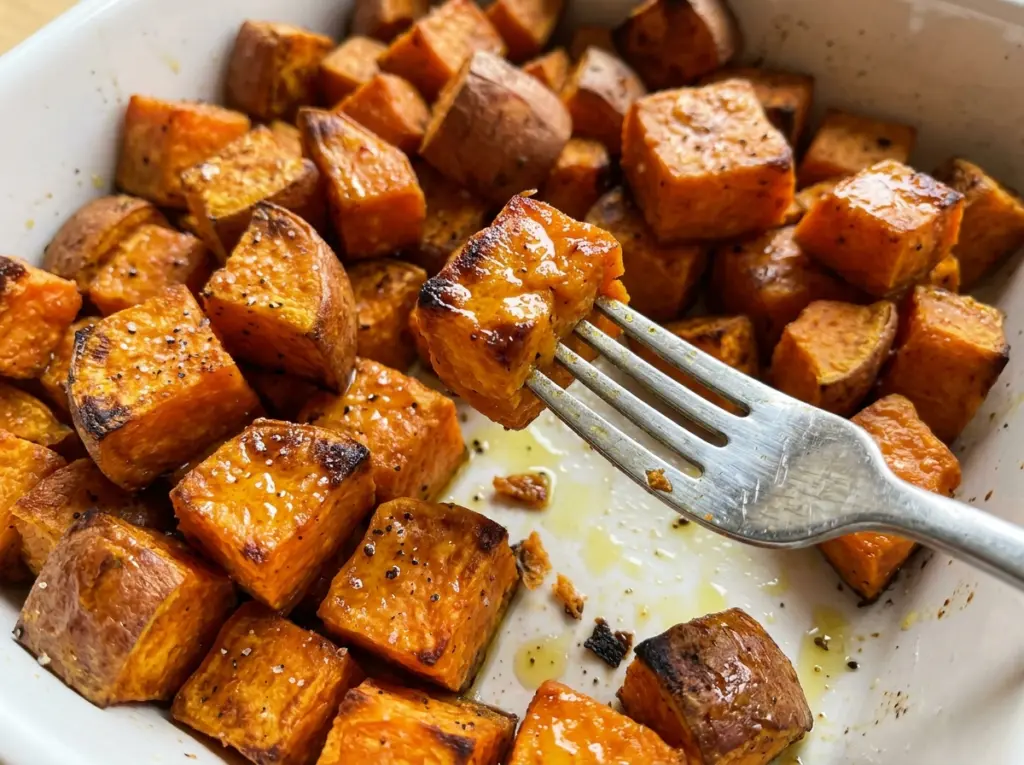
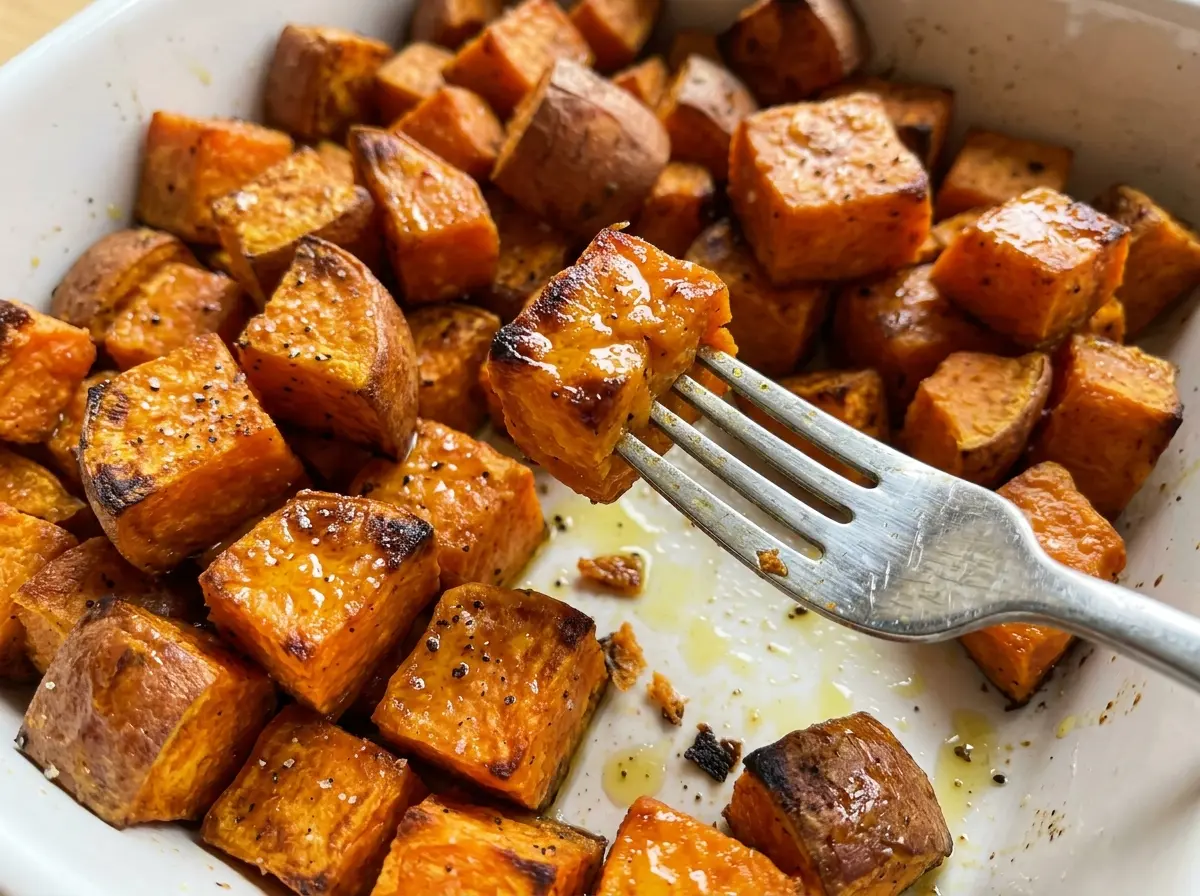
When the baking sheet comes out of the oven, the sweet potato cubes don’t all look alike: some have browned edges, while others are still bright orange on top. That’s exactly what I want. At 425°F, the edges pick up color while the centers turn tender, giving these roasted sweet potato cubes a mix of lightly crisp outside and soft inside without a long ingredient list.
I peel the potatoes and cut them into even 3/4-inch cubes so they roast at about the same pace. A toss with olive oil, kosher salt, and black pepper coats each piece before it goes onto a parchment-lined baking sheet. Turning the cubes halfway through gives more sides a chance to brown.
The timing has a little range, so I use the edges and a fork to judge the finish rather than expecting every cube to look identical. They’re ready when the edges are browned and a fork slips into the centers easily.
Kitchen Note
I cut the cubes to a consistent 3/4 inch instead of eyeballing the size. When some pieces are much smaller than others, the little ones soften before the larger cubes are ready.
Save these roasted sweet potato cubes for a simple side with browned edges and tender centers.
Why the Edges Brown Before the Centers Turn Soft
Sweet potato cubes don’t brown like little roasted potatoes with crisp color on every side. The edges and the spots touching the baking sheet usually color first, while the tops can stay orange. Waiting for every face to turn deeply brown can leave the centers softer than you want, so I look for browned edges and check tenderness with a fork.
The balance comes from the cube size and the hot oven. A 3/4-inch piece has enough time to become tender inside while its exposed surfaces roast; much larger pieces take longer to soften, and tiny ones can lose their tender shape before the larger pieces catch up. The single layer also matters: cubes need space around them so they roast rather than sit crowded together.
There’s no need to chase a uniform color across the whole pan. Some variation is normal, and it gives you a useful cue: browned edges with tender centers are the finish to aim for, not dark color on every surface.
What the Sweet Potatoes, Oil, and Seasoning Each Bring

- Sweet potatoes — Choose firm potatoes without soft spots. Peeling gives the cubes a tender, even bite, and cutting them into consistent pieces helps them finish together. No specialty variety is needed; ordinary grocery-store sweet potatoes work well.
- Olive oil — The oil helps the salt and pepper cling and gives the surfaces a light coating as they roast. Regular olive oil is fine here; there’s no need to use an expensive finishing oil. If you prefer a milder olive flavor, choose a mild-tasting olive oil rather than one with a pronounced peppery note.
- Kosher salt — Salt brings out the potatoes’ natural sweetness and keeps the finished cubes from tasting flat. Kosher salt is the seasoning used here, and its crystals are easy to distribute while tossing. Fine table salt measures differently by volume, so it isn’t a direct one-for-one swap.
- Ground black pepper — Pepper adds a gentle savory bite that balances the sweet, roasted flavor. Standard ground black pepper works; a specialty grind isn’t necessary. For a pepper-free batch, leave it out rather than replacing it with another spice.
From Even Coating to Browned, Fork-Tender Cubes
Get the Oven and Baking Sheet Ready
Preheat the oven to 425°F and line a large rimmed baking sheet with parchment paper. Give the oven time to reach temperature before the potatoes go in, so the roasting starts in a properly heated oven. The rim keeps the cubes on the sheet when you turn them.
Coat Each Cube in the Bowl
Put the peeled, 3/4-inch sweet potato cubes in a large bowl with the olive oil, kosher salt, and ground black pepper. Toss until the surfaces look evenly coated, with no dry patches of seasoning gathered at the bottom. A large bowl gives you room to turn the cubes without spilling them.
Roast, Turn, and Check for Tenderness
Spread the coated cubes in a single layer on the prepared baking sheet, then roast for 25 to 35 minutes. Turn them halfway through so more than one side has a chance to brown. Look for browned edges, then pierce a cube with a fork; it should feel tender rather than firm in the center. Start checking near the shorter end of the time range, since individual ovens and potato pieces can vary.
Small Changes for a Different Batch
Make a Half Batch
For two servings, use 1 pound of sweet potatoes, 1 tablespoon olive oil, 3/8 teaspoon kosher salt, and 1/8 teaspoon ground black pepper. Keep the same cube size, oven temperature, and roasting method; begin checking within the usual 25-to-35-minute window.
Leave Out the Pepper
Omit the ground black pepper for a milder, sweeter-tasting side. The potatoes still roast the same way, but you’ll lose the pepper’s gentle bite; keep the olive oil and kosher salt so the cubes remain evenly coated and seasoned.
Use Less Salt
For a lower-sodium version, reduce the kosher salt or omit it. The sweet potatoes will still brown and turn tender, though the flavor will taste less savory. This is a simple adjustment that doesn’t require changing the oven or the roasting method.
Storage and Reheating
- Refrigerator: Refrigerate leftovers within 2 hours in a covered container and use within 3 to 4 days. The cubes soften as they sit.
- Freezer: They freeze for up to 3 months, though thawed cubes will be softer. Cool them, freeze in a single layer until firm, then transfer them to a freezer-safe container.
- Reheating: Microwave in short bursts, turning the cubes between bursts, until they reach 165°F. Long microwave stretches can make the edges soft instead of pleasantly browned.
Questions That Come Up With Roasted Sweet Potato Cubes
Roasted Sweet Potato Cubes
Ingredients
Equipment
Method
- Preheat the oven to 425°F.
- Line a large rimmed baking sheet with parchment paper.
- Toss the sweet potatoes with the olive oil, salt, and pepper in a large bowl until evenly coated.
- Spread the cubes in a single layer on the baking sheet.
- Roast for 25 to 35 minutes, turning them halfway through, until browned at the edges and tender when pierced with a fork.


